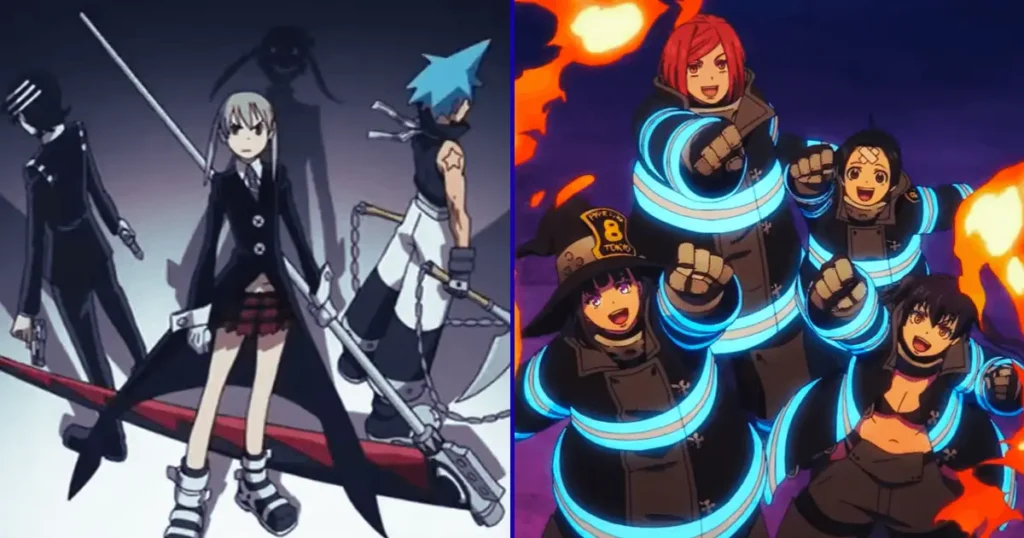
If you’ve been reading Fire Force while also being a lifelong Soul Eater fan, you’ve probably clocked some things that felt a little too familiar — a number that keeps popping up way more than coincidence should allow, a sword with an attitude problem that felt oddly specific, an assassin clan whose name rang a bell. For years, that was just chalked up to a mangaka having fun with self-referential Easter eggs. Then the final chapters of the Fire Force manga dropped in 2022, and it turned out to be so much bigger than that: Fire Force isn’t just similar to Soul Eater. Fire Force is, canonically, the prequel to Soul Eater — and this breakdown walks through exactly how that connection works, piece by piece.
Do Fire Force and Soul Eater Actually Take Place in the Same Universe?
Yes — and this isn’t fan theory territory anymore, it’s canon. Atsushi Ohkubo, the creator of both series, confirmed the link through Fire Force’s final chapters, and he left zero room for interpretation: the scorched, rebuilt world at the end of Fire Force is, literally, the earliest form of the world Soul Eater takes place in. This isn’t an isolated reference or a “similar parallel universe” situation — it’s the same timeline, with one specific event acting as the direct bridge between the two stories.
If you only know Fire Force from the anime, this might be news to you — the connection doesn’t become explicit until the manga’s endgame, so anyone who dropped off before the finish line simply hasn’t seen this reveal yet.
Which Comes First: Fire Force or Soul Eater?
This is where most of the confusion comes from, and it’s worth separating two things that get mixed up easily: publication order and in-universe chronological order.
Publication-wise, Soul Eater came first — it launched in 2004, while Fire Force didn’t start until 2015, almost a full decade later. But inside the actual story Ohkubo built, the order flips completely: the events of Fire Force happen before the events of Soul Eater. Fire Force isn’t a sequel or a spin-off — it’s a prequel, set earlier in the same timeline, one that wraps up at the exact moment the world of Soul Eater begins to exist.
How Did Shinra Create Death, the Grim Reaper From Soul Eater?
This is the most direct — and honestly the most jaw-dropping — link between the two series. During Fire Force’s final arc, Shinra Kusakabe undergoes a transformation that pushes him into a near-godlike state, reached after he contains the Great Cataclysm that consumes most of the world. It’s during this exact moment that Shinra directly creates the entity that would go on to become the Shinigami known simply as Death in Soul Eater — the same figure who founds Shibusen Academy and basically runs the entire mythology of that series.
In other words: Soul Eater’s most iconic death god didn’t exist before Fire Force’s ending. He’s born directly from the actions of another series’ protagonist, which quietly makes Shinra a foundational figure in Soul Eater’s mythology without him ever physically showing up in that story.
Why Does the Moon in Soul Eater Have That Creepy Smiling Face?
That unsettling smiling moon is one of Soul Eater’s most iconic — and iconically unsettling — visuals, and according to the reading this connection sets up, it’s not just gothic aesthetic for the sake of it. During the Great Cataclysm in Fire Force, the moon gradually starts taking on that same warped expression, acting as a visual stand-in for the transformation the world is going through: shifting from a reality centered on life to one shaped by the death and madness unleashed during the disaster.
When Shinra finally rebuilds the world at the end of Fire Force, that residue of destruction and despair doesn’t fully disappear — it gets permanently stamped into the sky itself. That’s the theory behind why the moon “smiles” so eerily over Death City in Soul Eater: it’s literally wearing the memory of the cataclysm that created that world.
What Happened to Pyrokinesis After Fire Force’s Ending?
Fire Force’s entire power system revolves around spontaneous combustion — people turning into Infernals or gaining control over fire itself. Soul Eater runs on a completely different logic: the “Soul Wavelength” system, built around soul resonance between humans and weapons capable of taking human form.
Fire Force’s ending treats this as an era shift, not a plot hole between the two shows: when Shinra closes the loop on the spontaneous combustion crisis plaguing that world, he also closes the chapter on the entire power system that Fire Force was built on. Whatever comes next — including the soul-and-resonance logic that governs Soul Eater — belongs to a brand-new era, built on the ashes of the last one.
The Easter Eggs That Were Hiding in Plain Sight All Along
One of the coolest parts of this whole reveal is realizing it wasn’t pulled out of nowhere in the final chapters — specific clues had been scattered throughout Fire Force for years, just waiting to be connected.
The Number 8
Ohkubo has a track record of using numbers as a kind of signature throughout his work, and the number 8 shows up constantly across Fire Force — in details that, on their own, read as just an aesthetic quirk of the author, but that hit different once you clock them as a deliberate bridge between the two series.
Arthur Boyle’s Excalibur
One of Fire Force’s most comedic characters, Arthur Boyle, wields a sword named Excalibur — and that’s no coincidence. That exact weapon, with the same insufferably quirky personality that made it (in)famous across Soul Eater and Soul Eater NOT!, carries over into the new era of the world, holding onto the consciousness Arthur imprinted on it before the world-ending transformation.
The Star Clan and Black☆Star
In Soul Eater, Black☆Star belongs to the Star Clan, an assassin bloodline with a well-established history and identity in that universe. The connection to Fire Force suggests this clan’s roots trace back to the world before the Great Cataclysm — another piece that seemed like a throwaway clan name on its own, but that clicks into the bigger puzzle Ohkubo was building the whole time.
Do I Need to Watch Fire Force Before Soul Eater Now?
It’s not required, but it does make a lot of sense if you want the experience in the order the creator actually designed. Since Fire Force functions as a prequel, watching it first lets you witness the birth of Soul Eater’s world before meeting that world already fully built — kind of like watching a prequel trilogy before the original trilogy.
That said, longtime Soul Eater fans who discovered Fire Force later aren’t missing anything essential by experiencing them out of order — the connection works more like a bonus layer of context and recognition than a hard requirement to understand either story on its own.
Is There a Third Project Connecting the Two Series? What Is “Soul World”?
This is the newest piece of the puzzle. The term “Soul World” actually comes from a specific line at the very end of the Fire Force manga — something along the lines of “next up, Soul World” — and it’s since become a catch-all term fans use to speculate about a possible third project set in this shared universe.
Nothing has been officially announced as of now, but Ohkubo himself publicly stated in early 2026 that he’s fully open to coming back to support any new project tied to Fire Force or his other work, should something move forward. That reignited a ton of community interest — whether it’s hype for a brand-new project, or hope for a Soul Eater remake that’s more faithful to the original manga than the 2000s anime adaptation ever was.
Did Ohkubo Always Plan This Connection, or Did He Decide Midway Through?
This is where things get into interpretation territory, since Ohkubo himself has never publicly broken down the creative process behind this decision. Fans generally land in one of two camps: the first argues that the Easter eggs planted since the earliest seasons — the number 8, visual callbacks, clan names — are proof of a deliberate plan, built over years, specifically to eventually merge the two series. The second, more skeptical take suggests the connection might have been decided partway through Fire Force’s production, as a creative (and commercially smart) way to give the series a memorable send-off by leaning on the love fans already had for Soul Eater.
Realistically, the truth is probably somewhere in between: some of the subtler Easter eggs likely started as low-key homages to Ohkubo’s earlier work, and only later did he decide to turn them into a fully canonical connection. Either way, the payoff works well enough to support both readings.
Does This Reveal Change How We Should Read Soul Eater?
Subtly, yes. Knowing the smiling moon carries the emotional residue of an earlier catastrophe, or that Death was born from a conscious act by another series’ protagonist, adds a layer of historical weight to elements of Soul Eater that used to read as just aesthetic choices or loose worldbuilding. It doesn’t rewrite the core story — Death is still Death, Death City still works exactly like it always has — but it does invite a closer rewatch, one where details that used to look like pure gothic style now carry real origin-story weight.
Final Thoughts
What started as a handful of visual coincidences between two shows in wildly different genres ended up becoming one of the most ambitious connections a mangaka has ever built between two separate works: Fire Force doesn’t just pay tribute to Soul Eater — it literally gives birth to the world Soul Eater takes place in. From the creation of Death to the explanation behind that unsettling smiling moon, every piece of this reveal retroactively reshapes how we look at both stories — and leaves the door wide open for whatever “Soul World” ends up meaning down the line.
Did you already suspect this connection before the official reveal, or did Fire Force’s ending catch you completely off guard? Drop a comment and let us know which Easter egg surprised you the most.