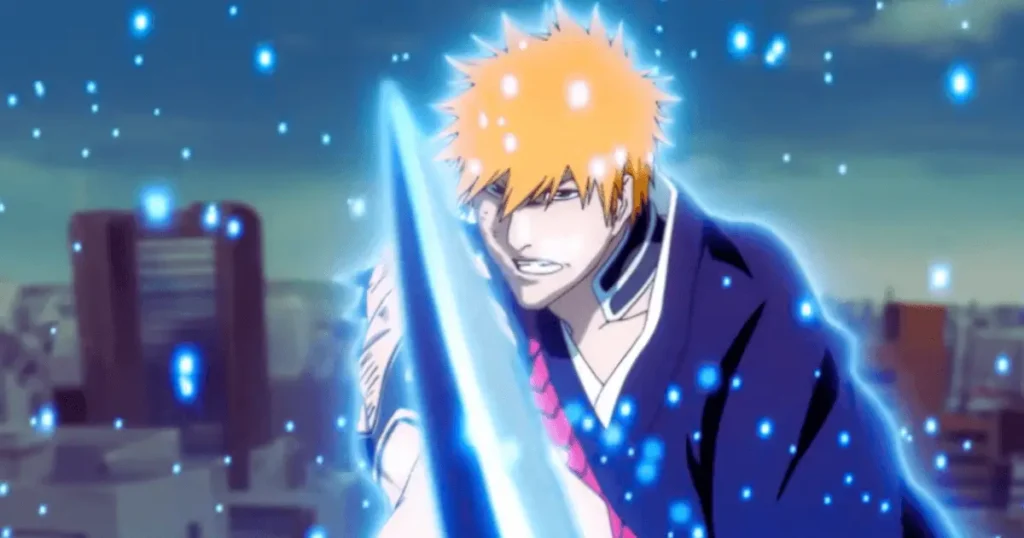
Shikai and Bankai aren’t just “sword transformations” — they’re the physical manifestation of the wielder’s own soul. And there’s an explanation straight from Tite Kubo that most fans have never actually read, because it never showed up inside the manga itself: Shikai reflects the user’s power; Bankai manifests the sword’s own ego. That one line rearranges pretty much everything we think we understand about Bleach’s entire power system.
This article walks through, step by step, what a Zanpakutō actually is, how Shikai and Bankai work under the hood, why Ichigo pulled off in three days what takes other Shinigami a decade, and the theories the community keeps building on top of all this.
What a Zanpakutō Actually Is
The Zanpakutō is every Shinigami’s primary weapon — used both to defeat Hollows and to send spirits to the afterlife. But treating it as “just a weapon” is exactly the mistake the story spends hundreds of chapters trying to correct: it’s a sentient being, born from the very soul of the Shinigami carrying it.
Every one of them traces back to Ōetsu Nimaiya, a member of the Royal Guard responsible for forging the so-called Asauchi — blank blades created by fusing thousands of Shinigami souls together. The full process works roughly like this:
| Stage | What happens |
|---|---|
| Asauchi | Nimaiya forges the blade by fusing thousands of souls |
| Imprinting | The Shinigami imprints their own soul’s essence onto that blade |
| Communication | Through Jinzen (meditation), they learn the spirit’s name inside their Inner World |
| Shikai | First release — reflects the user’s power in the sword |
| Bankai | Final release — manifests the sword’s already-developed ego |
Nobody sums this concept up better than Nimaiya himself, in chapter 525, when he confronts the captains and asks whether they’ve been treating their Zanpakutō as tools, subordinates, partners, or family — concluding that every single one of them had the relationship completely wrong. The question he leaves hanging is exactly the central provocation: so who’s actually superior here — the Zanpakutō, or the Shinigami?
Shikai: The Initial Release
Shikai is the Zanpakutō’s second form — or, in some cases, the first upgraded form. It only activates once the Shinigami learns their spirit’s actual name and manages to harmonize with it. In practice, it requires reciting a specific command (the Kaigō) along with the Zanpakutō’s name, which changes the blade’s shape and unlocks its own abilities.
Shikai generally fall into three broad categories: direct melee types, focused on physically transforming the weapon — like Renji’s Zabimaru, Ikkaku’s Hōzukimaru, and Kenpachi’s Nozarashi; Kidō types, built around energy or elemental effects — like Yamamoto’s Ryūjin Jakka, Aizen’s Kyōka Suigetsu, and Tōsen’s Suzumushi; and hybrids, which blend both logics, like Ichigo’s Zangetsu and Hitsugaya’s Hyōrinmaru.
A few examples worth highlighting:
| Shinigami | Zanpakutō | Command | Core ability |
|---|---|---|---|
| Ichigo | Zangetsu | None (always active) | Getsuga Tenshō |
| Byakuya | Senbonzakura | “Scatter, Senbonzakura” | Controls thousands of blade fragments |
| Hitsugaya | Hyōrinmaru | “Sit upon the frozen heavens” | Manipulates ice and weather |
| Renji | Zabimaru | “Roar, Zabimaru” | Segmented long-range attacks |
| Kenpachi | Nozarashi | “Drink, Nozarashi” | Drastically boosts cutting power |
| Rukia | Sode no Shirayuki | “Dance, Sode no Shirayuki” | Ice-based attacks |
Two details that tend to fly under the radar: Yumichika deliberately hides his true Shikai, releasing his sword under the fake name “Fuji Kujaku” to disguise the fact that it’s actually a Kidō type — something that clashes with the 11th Division’s unwritten culture, where everyone’s supposed to wield direct-combat Zanpakutō. And Zangetsu, Ichigo’s sword, never once appears in its sealed form: his spiritual power is high enough to keep his Shikai permanently active, a trait the story associates with exceptionally high-level Shinigami.
Bankai: The Final Release
Bankai is the Zanpakutō’s final and most powerful form — but the process to reach it is radically different from Shikai’s. While Shikai requires entering the Inner World and learning the spirit’s name, Bankai demands the opposite: materializing that spirit in the real world and subduing it in direct combat.
The norm within Soul Society is that this takes more than ten years of training, and the power jump is brutal — usually described as five to ten times stronger than Shikai. Some well-known examples:
| Shinigami | Bankai | What it does |
|---|---|---|
| Ichigo | Tensa Zangetsu | Extreme speed, black Getsuga |
| Byakuya | Senbonzakura Kageyoshi | Giant avatar formed from blade fragments |
| Hitsugaya | Daiguren Hyōrinmaru | Freezes objects — and, once complete, even concepts |
| Renji | Sōō Zabimaru | Large-scale combat avatar |
| Suì-Fēng | Jakuhō Raikōben | Devastating single-use missile |
| Mayuri | Konjiki Ashisogi Jizō | Adaptable, customized poison |
There’s a rule that completely separates the two forms, and it’s a brutal one: a broken Shikai regenerates; a broken Bankai doesn’t. A destroyed Bankai is usually gone for good — only Nimaiya or Orihime can fix it. Ikkaku and Renji both permanently lost their own Bankai because of this exact rule.
But the story also shows exceptions that reinforce this article’s central argument: Komamura can regenerate his own Bankai because his bond with his spirit is strong enough that healing himself also heals the sword; Hitsugaya regenerates his as long as there’s water in the air (ice is water, after all); and Mayuri simply rebuilds his Bankai from scratch every time it breaks, since he never fixed it the traditional way to begin with. In every single case, what determines the exception is the nature of the bond — not the user’s raw strength.
The Difference Kubo Explained Outside the Manga
Here’s the point this whole article is named after. You won’t find the clearest explanation of Shikai versus Bankai anywhere in the manga itself — Kubo saved that one for Klub Outside, his official Q&A platform. The wording is direct: Shikai is the state where the user’s power reflects itself in the sword; Bankai is the state where the sword’s own ego, already born and fully developed, manifests itself.
| Aspect | Shikai | Bankai |
|---|---|---|
| Source of power | The user projects their own power | The sword manifests its own ego |
| Relationship | The user masters the sword | User and sword operate as one |
| Time to master | Years of training | Over a decade, with a deep bond |
| Power increase | 2 to 3× the base form | 5 to 10× Shikai |
| Frequency | Common among Shinigami | Rare — usually captains and lieutenants |
And there’s concrete proof of this baked right into the story. During the Thousand-Year Blood War, the Quincy steal the captains’ Bankai using the Medallion. Hitsugaya, even without his Bankai, can still use his Shikai completely normally — and the reason lines up perfectly with Kubo’s explanation: Shikai comes from the user, who projects their own power onto the blade. Bankai doesn’t work that way: it depends on the sword’s own ego, and with the spirit stolen away, there’s simply nothing left to manifest.
The implication here is huge: in Shikai, the spirit still functions almost like a blank page receiving the Shinigami’s projection. In Bankai, that spirit has already developed its own personality — and the power that shows up doesn’t belong to the user alone, it belongs to both of them. That’s exactly why Bankai is so much stronger, and also exactly why it’s so rare: it requires a level of bond most Shinigami never manage to build.
Tenshintai: How Ichigo Pulled Off in Three Days What Takes Ten Years
In chapters 132 through 134, Yoruichi introduces Ichigo to a device made by Urahara: the Tenshintai, a doll capable of piercing the Zanpakutō and forcing the spirit to materialize in the real world — exactly the hardest requirement for reaching Bankai.
The method works, but with one very specific limit: the spirit only stays materialized for about three days, reverting back into doll form after that. And training past that window, according to Yoruichi’s own warning, can be fatal.
The detail almost nobody brings up: Ichigo wasn’t the first person to use this shortcut. Yoruichi reveals that Urahara himself also achieved Bankai in three days — meaning he tested his own invention on himself before anyone else. That’s exactly why Yoruichi knew the risk so well: she’d already watched the process happen up close before.
Planted Details a Lot of People Only Caught Later
- Ichigo always trained with the Hollow, not the Quincy. “Old Man Zangetsu,” who appears in his Inner World, is actually a fragment of Yhwach — the Quincy side. The true Shinigami spirit of his Zanpakutō was always the Hollow Zangetsu, the exact one who trained Ichigo through the entire Bankai process. The Old Man had been suppressing part of his power the whole time.
- The broken-Bankai rule has exceptions, and they’re not random. As shown above, the ones who can regenerate are the ones with an exceptional bond to their own spirit — reinforcing the reading that Bankai is about relationship, not equipment.
- Yumichika’s Zanpakutō has its own opinion. His spirit hates being called by the fake name, and the story spells out that frustration explicitly — a small detail confirming these beings have personality, will, and even resentment of their own.
- Zangetsu is never sealed. A constant reminder, spread across hundreds of chapters, that Ichigo was always an anomaly within the story’s own power system.
Three Theories the Community Never Stops Debating
Heads up: the readings below are fan theory, not confirmed by the show.
Theory 1 — Bankai isn’t actually the final stage. The evidence leans this way: Ichigo unlocks a brand-new True Bankai after training with Nimaiya, with two blades and power way beyond his previous form; Hitsugaya completes his own Bankai after 18 months of maturing, gaining the ability to freeze not just objects but concepts; and Komamura reaches a state of invulnerability through his own Humanization. The hypothesis: there’s room for True Bankai, complete Bankai, and modified Bankai to exist as separate stages — with Nimaiya, as the ultimate forger, capable of reforging any of them.
Theory 2 — Zanpakutō spirits can genuinely die. If the spirit is born with the Shinigami and dies with them, and a destroyed Bankai doesn’t regenerate without Nimaiya or Orihime stepping in, the natural reading is that destroying a Bankai is equivalent to permanently killing that spirit. The Quincy stealing Bankai during the war reinforces this: those spirits were literally separated from their own owners.
Theory 3 — Arrancar Resurrección might be a “Hollow Bankai.” The logic: while Bankai manifests the sword’s ego, Resurrección restores and manifests the Hollow’s original powers. Tōsen is the case most often cited as a bridge between the two systems, having access to Shikai and Bankai as well as Resurrección thanks to his Hollowfication. If the mechanics really are equivalent, it would open the door for Arrancar to reach evolved stages similar to True Bankai.
What This All Means About Bleach’s Power System
The conclusion running through every one of these points comes down to one thing: Shikai and Bankai were never conventional shonen “power-ups.” They’re manifestations of the soul, and the variable that matters most isn’t raw strength — it’s the quality of the bond between Shinigami and Zanpakutō.
That’s exactly why Nimaiya’s provocation works so well as the central thesis of the entire story: treating your Zanpakutō as a tool is, literally, wasting half your own power. Whoever builds a real partnership grows alongside their sword. Whoever doesn’t stays stuck in Shikai forever — projecting power onto a blade that never got the chance to find its own voice.