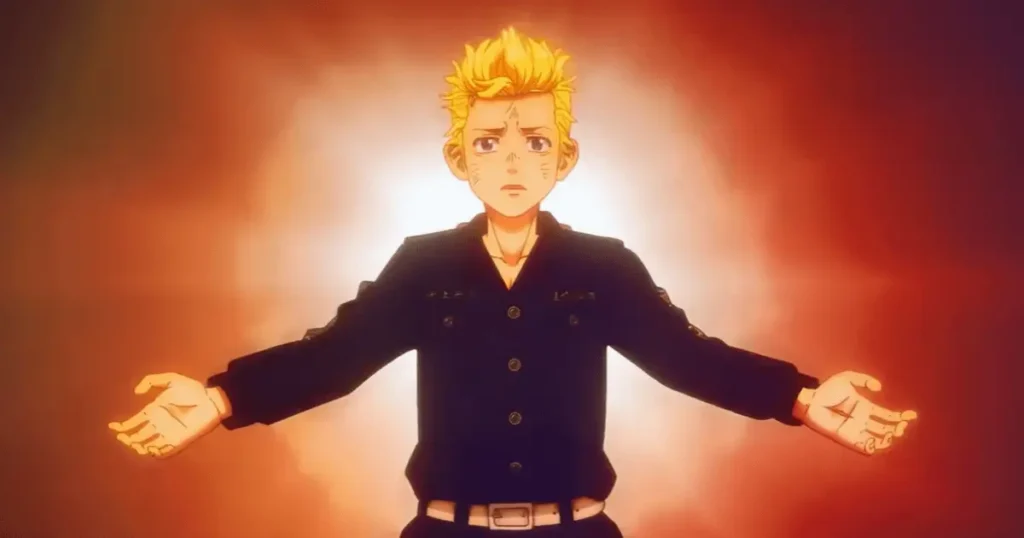
Time travel as a tool to fix past mistakes isn’t exactly a new premise in anime, but the way Tokyo Revengers blends that sci-fi concept with the raw violence and honor codes of Japanese school gangs turned Ken Wakui’s manga into a full-blown cultural phenomenon. The story follows Takemichi Hanagaki, a frustrated 26-year-old going nowhere in life, who learns that his only girlfriend from his teenage years, Hinata Tachibana, was murdered by the dreaded Tokyo Manji gang. After getting shoved onto subway tracks, Takemichi wakes up twelve years in the past, suddenly handed a shot at rewriting history. What looks like a simple rescue mission, though, quickly spirals into a tangled, time-bending puzzle, where tugging on a single thread of the past can unravel futures that are even more tragic than the one he started with.
For anyone just jumping in, or casually catching up on past arcs, Tokyo Revengers’ timeline can feel like a maze. The gears of the plot shift direction with every decision the protagonist makes, and understanding the rules governing these time jumps is step one to grasping why saving a single life forces Takemichi to go up against Konoha’s underworld again and again.
How Takemichi’s Time Jumps Actually Work
Unlike stories where time travel lets a character hop to any point they want, Tokyo Revengers plays by strict, narrow rules. The trigger for each jump is purely emotional, and it depends on a shared, powerful wish between two people: Takemichi and Naoto Tachibana, Hinata’s younger brother. When the two of them shake hands, the power activates, sending the protagonist’s consciousness exactly twelve years into the past. Here’s the crucial detail: time runs strictly in parallel across both eras. If Takemichi spends a week back in his school days, a full week passes in the present too by the time he returns — meaning he can never just “pick” the exact moment he wants to land on.
That real-time mechanic is what gives the story its suffocating sense of urgency. Takemichi doesn’t get the luxury of messing up and simply trying again on the same day; every single change he makes triggers an immediate domino effect in the present. On top of that, present-day Takemichi’s body slips into a trance-like, coma state while his mind is off in the past, which means Naoto has to protect his unconscious body in the present while simultaneously tracking every shift in the flow of history — turning their partnership into a race against the clock, where the present keeps rewriting itself in ways neither of them can predict.
The Rise of Tokyo Manji: Toman’s Original Purpose
To understand just how dark the future gets, it’s essential to look at the roots of the organization Takemichi is trying to tear down. Tokyo Manji — or simply Toman — didn’t start out as a criminal syndicate built on murder, extortion, and drug trafficking. It was actually founded by a group of six childhood friends: Mikey, Draken, Baji, Mitsuya, Pah-chin, and Kazutora. The original goal was almost chivalrous in its idealism: build a biker gang tough enough to go toe-to-toe with the older crews running the region, all under the unshakable motto of “one for all, all for one.” Mikey dreamed of changing the entire world of delinquents, building a new generation defined by loyalty, respect, and the idea that its members would always have each other’s backs.
That adolescent utopia collapses the moment an outside force enters the picture: Kisaki Tetta. Recognizing that Manjiro Sano, better known as Mikey, had unmatched physical strength paired with an emotionally fragile mind prone to darkness, Kisaki builds a long game to become the brains pulling the strings behind the leader. By systematically stripping away Mikey’s “emotional anchors” — his brother Shinichiro, his sister Emma, and his best friend Draken — Kisaki cuts Toman’s leader off from the real world. With no one left to guide him or hold his violent impulses in check, Mikey gives in to despair, letting Kisaki twist a gang of childhood friends into the cruel, billion-yen criminal empire Takemichi finds waiting for him in the present.
The Domino Effect: Changes Across the Arcs
Takemichi’s journey to break this cycle of tragedy is built on small victories in the past that end up triggering devastating consequences in the future. In the first major arc, centered on the rivalry with the Moebius gang, the protagonist’s goal is to stop Draken from dying at the August festival. Takemichi succeeds in saving Toman’s vice-captain, but when he returns to the present, he discovers that Draken’s survival wasn’t enough to save Hinata. Kisaki’s influence had already dug in far too deep, proving that fate’s underlying structure was going to demand even bigger sacrifices.
That “action and reaction” pattern hits its peak during the Valhalla and Black Dragons arcs. While trying to bring Baji back into the gang and prevent the deadly showdown known as “Bloody Halloween,” Takemichi watches Baji make the tragic sacrifice that protects Mikey and Kazutora’s sanity. Later, dealing with the tyranny of the tenth-generation Black Dragons led by Taiju Shiba, the protagonist manages to unify the rival gangs under Toman’s banner — but every single interference just sharpens Kisaki Tetta’s strategy in the present. It plays out like a game of temporal chess where the villain seems to anticipate every move, forcing Takemichi to evolve from a cowardly kid into the genuine “crybaby hero” the gang actually needed to hold onto its soul.
Toman’s Fate and Its Impact on Tokyo Revengers’ Future
As the story pushes toward its final arcs — including the massive-scale showdown against Tenjiku — it becomes clear that this conflict was never going to wrap up with a simple, traditional happy ending. The psychological weight piling up on Takemichi’s shoulders, combined with Mikey’s emotional burnout, turns the back half of the series into a test of mutual resilience. Mikey’s decision to officially dissolve the original Toman comes across as a desperate attempt to save his friends from the bleak future Kisaki had designed for them, but the darkness eating away at the leader himself proves that the thread tying him to the world’s fate demands one last, definitive change to the timeline.
In its final stretch, Tokyo Revengers delivers an ending that splits opinion, but it does deliver on the story’s core promise: rewriting the past from the roots up. By pulling off the definitive time jump that takes him all the way back to childhood, standing beside Mikey, Takemichi doesn’t just save Hinata, Baji, Draken, and Emma — he gets to build Toman on the pure, unbreakable ideals the group dreamed of back when it all began. The toll of reliving years of suffering and physical pain pays off the moment the present finally settles into a reality where nobody had to get left behind.
That, in the end, is Ken Wakui’s real triumph. More than just a street-fighting anime, the story holds up as a study of how much our choices matter, how strong brotherly bonds can be, and what it actually costs to protect the people we love when time itself seems stacked against us.