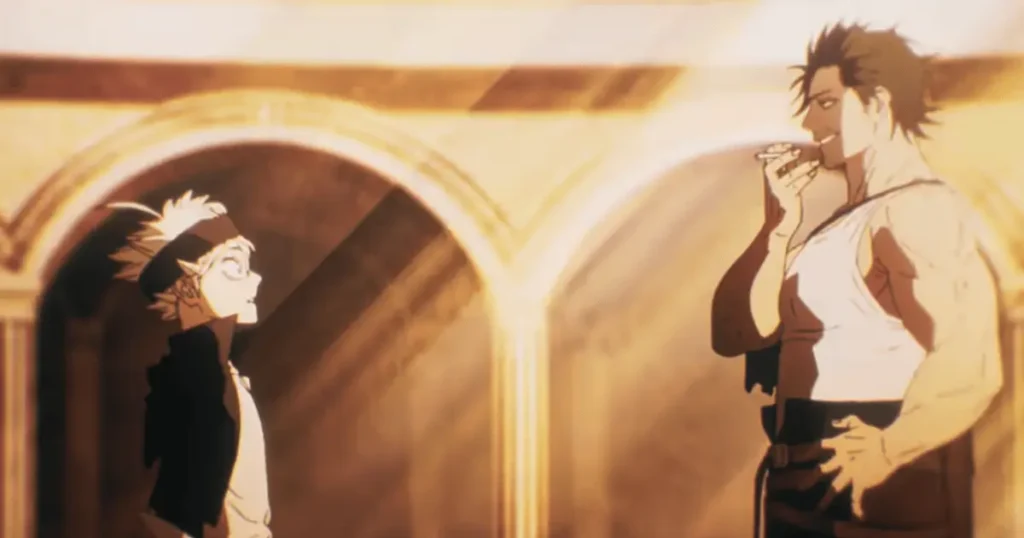
After more than five years of waiting — a hiatus that started in March 2021 and didn’t officially end until October 3, 2026 — Black Clover is finally back with the long-awaited episode 171, “The Battle Begins.” And no, this isn’t just a lukewarm comeback meant to warm the engine back up: the episode immediately gets to work laying out, with surgical precision, the pieces that are going to drive the brutal invasion of the Spade Kingdom.
In this piece, we’re breaking down the details that matter most from this return — from the real mechanics behind Asta’s new form to Yuno’s quiet growth, through the threat Morris now represents now that he’s switched sides, and wrapping up with an honest look at the technical leap the animation took in this new phase.
Devil Union and the New Dynamic Between Asta and Liebe
A big chunk of episode 171’s emotional weight comes from Asta and Liebe’s training under Nacht Faust’s supervision — and it’s worth understanding exactly what that training represents. Nacht makes it crystal clear, right from the opening scenes, that simply letting Liebe’s anti-magic flow through Asta’s body isn’t the same thing as actually achieving true Devil Union. He himself, capable of fully merging with his devils and folding their abilities into his own Shadow Magic, serves as the direct counterpoint: Asta and Liebe, for now, are still fighting as two separate individuals, just lending each other power rather than fusing into a single entity.
That distinction between “unlocking” the transformation and actually “mastering” it is the real heart of the episode. The training bout between the two of them and Nacht stretches across most of the premiere, and even then, the duo can only hold the complete Devil Union form for about one second — long enough for the sheer intensity of that instant to visibly rattle Nacht, but far too short for any premature celebration. It’s that kind of real, on-screen limitation, shown rather than just mentioned in dialogue, that makes Asta’s growth feel a lot more earned than some instant power-up.
But what really elevates this sequence isn’t just the power mechanics — it’s the tone of the partnership between Asta and Liebe. Instead of leaning on the tired “inner demon that needs to be forced into submission” cliché, the show builds something rarer: the two of them slowly learning to fight as genuine equals. There’s even a bit of comic relief where Liebe starts buying into Asta’s ideas for forming the Union, only for Asta himself to immediately undercut his own confidence with some clumsy follow-through — a small detail, but one that reinforces exactly that horizontal relationship between the two, with no “master and tool” hierarchy involved. It’s that balance between humor and genuine camaraderie that puts this duo among the best-built partnerships in modern shonen.
The Pieces on Spade’s Board: Yuno’s Target and the Morris Threat
While Asta takes up most of the premiere’s emotional focus, the episode doesn’t let the rest of the board go cold. Yuno reappears actively training for a new confrontation against Zenon Zogratis — a rematch loaded with dramatic weight, since his earlier defeat to the same opponent still hangs over the co-protagonist. That new training cycle, driven by the desire to rescue William Vangeance, gives the approaching war a personal layer that goes way beyond just “saving the kingdom”: it’s also about settling a defeat Yuno has been carrying for a while now.
On the other side of the board is Morris, and the episode makes it clear why he’s now a piece too dangerous to ignore. Driven out of the Diamond Kingdom, Morris finds a new home within the Dark Triad’s ranks — and quickly proves his worth to the villains. His strategic, scientific mind is exactly the kind of reinforcement that speeds up the Triad’s plans to fully open the gates connecting the world to the underworld, a threat that puts not just the Spade Kingdom but the existence of all three kingdoms at risk simultaneously. That level of urgency is what justifies why rescuing Yami and William stopped being a simple rescue mission and effectively became the spark for a war on a much larger scale.
Technical Evolution: The Cinematic Look and the Opening’s Secrets
After five years of waiting, the first question on every fan’s mind was inevitable: would the animation actually live up to the ambition of this new saga? Based on the prevailing response from critics and fans alike, the answer is a resounding yes. Pierrot opted for a more careful production pace for this second season, and it shows on screen through tighter fight choreography, bold use of restricted color palettes — like the sequence that strips everything down to white, black, and red during part of the training showdown, creating an almost experimental look — and subtle atmospheric touches, like floating particles that help sell the tension of the indoor spaces where Asta and Nacht face off. It’s not quite as radical a leap as what other prestige franchises have pulled off in their own recent comebacks, but it’s clear the studio hasn’t lost sight of what makes Black Clover fun even in its heaviest moments.
As for the new opening and the music accompanying this phase: it’s worth being cautious before treating any single image as a confirmed spoiler. A lot of what circulates among fans right after a premiere tends to be overblown readings of static frames pulled out of context — so for now, the safest move is to treat those visual theories as speculation, not as official confirmation of what’s coming later in the season.
The Pace of “The Battle Begins”: Is Black Clover Better Than Ever?
At the end of the day, episode 171 nails a structural choice that deserves credit: instead of burning half its runtime reminding viewers of everything that already happened, the premiere delivers only what’s essential and spends the rest of the episode simultaneously advancing Asta and Liebe’s training, Yuno’s preparation, Morris’ moves within the Spade Kingdom, and the local resistance’s uprising. That’s a tough balance to strike right out of the gate, and the community’s reception reflects that success, even with a few caveats — some fans praised how smoothly the transition between arcs played out, while others felt the adaptation moved a little too fast through certain stretches of manga material.
Either way, the episode pulls off exactly what an arc premiere needs to pull off: proving the production is ready to carry the most ambitious, grandest arc the franchise has ever attempted — and making it clear that the long wait, at least through this first chapter of the new phase, was worth it.
What did you think of the animation quality and Asta’s new transformation in this comeback? Was the wait worth it?