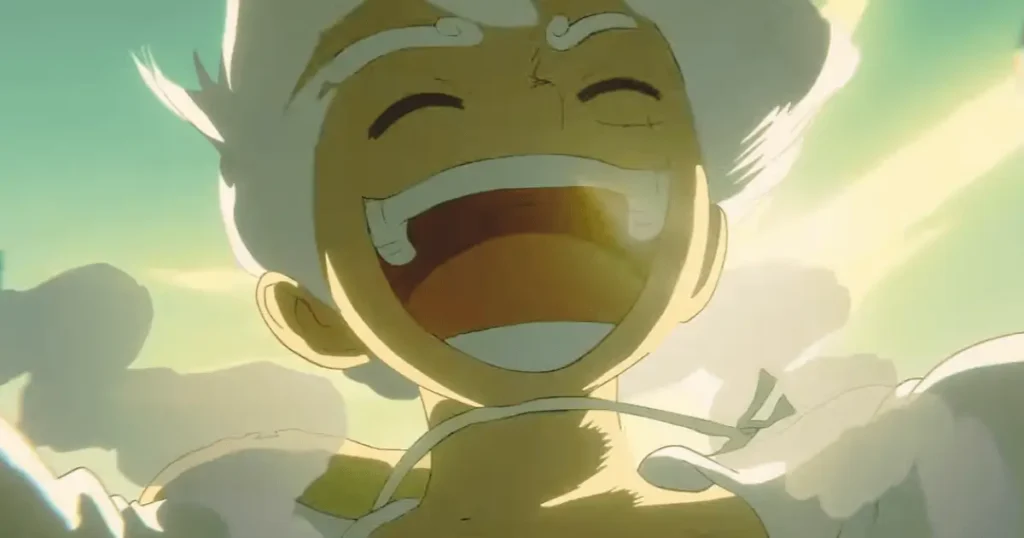
Few questions have followed One Piece for as long as this one: what does the D. stand for? The official answer is short and a little frustrating, because the story hasn’t given it yet. Even so, after more than a thousand chapters, Eiichiro Oda has scattered enough clues to paint a fairly sharp picture of what the D. represents, who carries it, and why the World Government treats it as a threat. The thread that ties it all together runs through Luffy, Roger and Joy Boy, the first pirate in history.
In this article we separate three layers that often get mixed together online: what the story has confirmed, what is fan theory, and what is rumor. Whenever something is our own interpretation, we’ll say so.
Spoiler warning: this article covers manga chapters the anime has not adapted yet, including Chapter 1171.
What Does the D. Mean in One Piece? What Is Confirmed
Here’s the direct answer: to this day, no page of the manga explains what the D. means. What exists is a handful of loose facts that, added together, narrow the problem down.
First, the D. appears as the middle initial of a small, specific group of characters, not as a family name, which already rules out the idea of a single clan. Second, it is passed down through bloodlines across generations, but today even most of the bearers don’t know what it means. Third, the World Government knows far more than it lets on. Fourth, Imu has already described the D. as the moniker of an ancient enemy of the Government. Fifth, Gol D. Roger is one of the few characters the story presents as knowing the meaning, after he reached Laugh Tale.
This set of facts, not a ready-made definition, is what supports every theory we’ll look at below.
What Is the Will of D?
The Will of D, the name fans gave to whatever the D. seems to pass from generation to generation, works as a central theme of the series: an inherited will that crosses decades and pushes its bearers to challenge the World Government, often without knowing exactly why.
It helps to separate two things. The D. itself is a name marker, a fact of the story. The Will of D is the thematic reading of that marker, an interpretation that gained traction because nearly all the major bearers share similar traits: charisma, contempt for hierarchy, and an easy relationship with their own mortality.
Will of D vs. the D. Clan: Are They the Same Thing?
Not exactly. “D. Clan” is the label fans use most often for the group of bearers, even though the story has never detailed how that group is structured. Since the D. is a middle name and not a surname, bearers aren’t necessarily related, and nothing suggests they all think or act alike. The “clan” is closer to a shared inheritance than a family in the traditional sense, and the “will” is what that inheritance carries.
Who Carries the D. in One Piece?
The mystery behind who truly carries the Will of D. in One Piece only gets deeper with each arc, as more characters tied to the enigmatic initial come into the story.
The table below lists the best-known bearers and what the story confirms about each, with no theories mixed in. It is not an exhaustive list.
| Character | Relationship to the D. | What the story confirms |
|---|---|---|
| Gol D. Roger | Bearer | Pirate King, reached Laugh Tale and learned the truth of the world |
| Monkey D. Luffy | Bearer | Protagonist and user of the Hito Hito no Mi, Model: Nika |
| Monkey D. Dragon | Bearer | Luffy’s father and leader of the Revolutionary Army |
| Monkey D. Garp | Bearer | Luffy’s grandfather and legendary Marine vice admiral |
| Portgas D. Ace | Bearer | Roger’s son and Luffy’s sworn brother |
| Marshall D. Teach | Bearer | Blackbeard, one of the Four Emperors |
| Trafalgar D. Water Law | Bearer | Captain of the Heart Pirates |
| Nefertari D. Lily | Bearer | Vivi’s ancestor, named by Cobra as a bearer of the D. in Imu’s presence |
The Monkey D. Family: Luffy, Dragon and Garp
Three generations of the same family carry the D. in their names, and the story makes a point of showing that they disagree on almost everything. Garp chose to serve the Marines, Dragon leads the Revolutionary Army against the World Government, while Monkey D. Luffy is determined to achieve his dream of becoming the Pirate King. The D. doesn’t push them to the same side, but it does put each of them on a collision course with the established order, in their own way.
Gol D. Roger and Portgas D. Ace
Gol D. Roger is the character around whom almost every D. theory revolves, precisely because he is the one presented as having discovered the meaning and taken it with him to the scaffold. His son Ace inherits the D. through his name and through his fate: like his father, he dies smiling, a detail we’ll come back to later.
Marshall D. Teach: The D. on the Opposite Side?
Marshall D. Teach is the piece that blocks any simplistic reading. Blackbeard carries the D. yet he’s a villain, which shows the D. is no seal of goodness. A popular fan reading sees a parallel between two pairs of bearers: Roger and Rocks D. Xebec on one side, Luffy and Teach on the other. Teach’s ship is named the Saber of Xebec, a nod to the legendary Rocks. That is interpretation, not confirmation, but it helps explain why the D. feels more like an inheritance of events than a personality trait.
Why Does the World Government Fear the D.?
The Five Elders’ fear of the D. is one of the strongest signs that it carries a dangerous meaning. Figures like Sengoku and the Gorosei themselves treat it as an existential threat. The story often sums up that threat with a phrase that has become almost synonymous with the topic: the “natural enemies of the gods,” meaning D. bearers as natural adversaries of the Celestial Dragons and everything they stand for.
That tension runs deep. When the World Government destroyed Ohara, the reason was the study of the Void Century, the erased period of history, and the scholars’ effort to decipher the Poneglyphs. Fear of the D. and fear of forbidden history are the same machine: both point to a truth the Government needs to keep buried.
What Did Imu Reveal About the D.?
Chapter 1085: The D. as the Name of an Ancient Foe
The first major statement came back in Chapter 1085. Imu tells Cobra that the D. is the moniker of an “ancient enemy” and that today’s bearers are little more than echoes who don’t understand what their name means. In the same scene, Imu blames Nefertari D. Lily for a blunder 800 years ago that let the Poneglyphs be scattered across the world.
Chapter 1171: “Elbaph Is D.”
Here is the most recent data point, and one of the most debated. In Chapter 1171, after King Harald’s death, Imu says that Elbaph can never be brought into the World Government because, as history has shown, the two are incompatible. The line that stuck with readers is short: Elbaph is D.
The problem is that this line is too broad and doesn’t spell out exactly what is being said. It isn’t clear whether all the giants carry the D. or whether the entire nation was, somehow, on the side that opposed the Government in the past. In our reading, the second option is the more likely, because it fits the idea that the D. was a collective moniker for allies rather than a mark of blood. In short, Imu’s “Elbaph is D” in Chapter 1171 suggests that the inheritance of the D. may reach entire peoples, not just individuals.
Is the D. Connected to Joy Boy?
The link to Joy Boy is the central hypothesis behind almost every theory, and it’s what gives this article its title: Luffy, Roger and Joy Boy form the line many fans try to draw. Before going further, let’s organize what is known.
Who Was Joy Boy?
Joy Boy is the first pirate in history, a figure from the Void Century tied to the Ancient Kingdom, whose war against the alliance of twenty kingdoms led to the formation of the World Government. The name doesn’t seem to be a proper name but a nickname, associated with someone who spreads joy and doesn’t despair.
The most concrete proof that he left marks on the present appears on Egghead. In Chapter 1122, the Iron Giant, Emet, released a knot holding a portion of Joy Boy’s Conqueror’s Haki, sealed inside him ages ago. The burst rolled across the island, knocked out countless Marines, cancelled the Devil Fruit transformation of the Five Elders, and sent them back to Mary Geoise. To understand why this kind of Haki is so rare, it’s worth reviewing how Haki works.
Nika, Joy Boy and Luffy: What’s the Difference?
The Nika vs. Joy Boy difference is one of the most common points of confusion for people just starting to study the topic. The short answer is that they are three distinct things. Nika is the legend of the Sun God, which gives its name to the fruit Luffy ate, the Hito Hito no Mi, Model: Nika. Joy Boy is the historical figure, the pirate from the past. Luffy is the fruit’s current user. Analyses of Chapter 1114 point precisely to this separation among the three, although the story hasn’t yet detailed the relationship between them.
Is Luffy the Reincarnation of Joy Boy?
This is the most popular search on the topic, and the honest answer is that nobody knows. Let’s look at both sides.
For: the fruit’s awakening in Luffy turned him into the symbolic embodiment of Nika, and the overlap between his wide grin, Roger’s, and Joy Boy’s feeds the idea that a single will keeps repeating. There is also a cyclical-reincarnation fan theory in which Roger would be a partial reincarnation and Luffy the complete one. Treat it as interpretation.
Against: another fan theory goes the opposite way: Luffy wouldn’t be a “chosen one” by prophecy but simply the first person in 800 years to truly align with the fruit’s will. Also, the separation between Nika, Joy Boy and Luffy suggests he could inherit a will without being the same person. For now, Luffy being Joy Boy’s reincarnation remains a hypothesis, not a fact.
What Did Roger Discover on Laugh Tale?
The search for what Roger discovered on Laugh Tale sums up the biggest mystery on Roger’s side of the story. We know that he and his crew read the truth of the world at Laugh Tale and reacted with laughter, and that the Roger Pirates’ journey is closely tied to the story of the first pirate, Joy Boy.
What he actually discovered, the story has yet to tell. But the link between Luffy, Roger and Joy Boy gets stronger when you remember that Roger carried the D., knew what it meant, and effectively handed the result of his discovery to a new generation: Luffy, and everyone who chased the treasure after his execution.
Why Do D. Bearers Smile?
The question of why D. bearers smile is one of the most emotional in the topic, because it mixes theory and fiction in a very particular way. The pattern is familiar: Roger smiles on the scaffold, Ace smiles as he dies, and the same image appears with other bearers, such as Portgas D. Rouge. Luffy’s wide grin completes the picture.
A popular theory proposes that the D. represents exactly that smile, the mark of someone who faces the worst without losing joy, which connects to the nickname Joy Boy. It’s a beautiful reading and consistent with the tone of the series, but it remains interpretation. No page of the manga says the smile is the meaning of the D.
Does the D. Stand for “Dawn”? The Romance Dawn Theory
The “Dawn” theory is one of the most talked about. The idea is that the D. would be the initial of “Dawn,” the presumed name of the first pirate crew, led by Joy Boy. The main argument is the title of the series’ very first chapter, “Romance Dawn,” which makes the “Romance Dawn D” look like a clue Oda planted from the start. Elbaph’s devotion to the Sun God Nika and to the “dawn” reinforces this reading.
The weak point is that nothing in the text directly ties the initial to the name of the crew. To us, “Dawn” works better as a thematic symbol than as the literal origin of the letter.
Other Theories About What the D. Means
The community has raised other explanations, each with strengths and weaknesses:
- The initial of Joy Boy’s real name: fits the idea that the D. is an inheritance from his allies, but forces you to explain why so many different bearers would share the same initial.
- The name of the Ancient Kingdom’s royal family: fits the Void Century, but it’s narrower than the “moniker of an ancient enemy” Imu described.
- Damashii (soul, spirit): connects the D. to the idea of an inherited will, but the evidence is purely linguistic.
- Devil or Danger: match the Government’s fear, but depend on a very literal reading of how the Government sees the bearers.
- Half-moon or semicircle: a reading of the letter’s shape, with no support in the plot.
- A mark or pact between Joy Boy and his allies: the idea that the D. is a promise shared by companions who chose to follow a common dream.
Our Take: Which Theory Makes the Most Sense?
This section is Animeleko’s own reading, not confirmation. In our view, the D. works more like a banner than a name: a moniker adopted by those who opposed the alliance that gave rise to the World Government, passed down from generation to generation. That reading fits the three things the story has already said outright: Imu called the D. the moniker of the Government’s ancient enemy, the Gorosei fear it as an existential threat, and in Chapter 1171 Elbaph was placed on the same side.
In this reading, “Dawn” and the smile are symbolic echoes of that inheritance, not the origin of the letter. And the Will of D stops being a power and becomes a legacy: the continuation of a dream of freedom that Joy Boy left unfinished and that each bearer, in their own way, tries to complete.
What to Expect From the D. in One Piece’s Final Saga
The manga returned on September 27, 2026, with Chapter 1194, and it was followed by yet another short break, so check the official channels for the date of Chapter 1195. On the anime side, Episode 1180 closed the first season of the Elbaph Arc on September 27, and the series has confirmed its return in 2027 with no window announced. The anime is still far from reaching the D. reveals covered here, so if you only watch the anime, everything we said about Chapter 1171 is a spoiler.
One important caution: with every new chapter, supposed “leaks” circulate online promising to reveal the meaning of the D. before official publication. Treat any revelation without an official source as rumor until it appears in the published chapter. To stay on top of the topic safely, check upcoming chapter dates on the official channels from Shueisha (MANGA Plus) and VIZ.
What Is Confirmed vs. What Is Still Theory
Confirmed by the story:
- The D. is a middle initial carried by a specific group of characters.
- It is passed down through bloodlines, and most bearers don’t know the meaning.
- The World Government knows what it represents and fears it.
- Imu called the D. the moniker of the Government’s ancient enemy (Chapter 1085).
- Imu says “Elbaph is D” (Chapter 1171).
- Roger read the truth at Laugh Tale, and Luffy carries the Hito Hito no Mi, Model: Nika.
Fan theory:
- Luffy is the reincarnation of Joy Boy.
- The D. is the initial of “Dawn.”
- The D. represents the smile of its bearers.
- Other readings, such as Damashii, Devil or Danger.
Rumor:
- Any “revelation” of the D. that appears in leaks before the official chapter.
Conclusion
What the D. means in One Piece still has no official answer, but the story has already given us the essentials: the D. is an inheritance, not a surname. It links Luffy, Roger and Joy Boy across centuries, it frightens the World Government, and in Chapter 1171 it reached all the way to Elbaph. What remains to be discovered is the exact origin of that inheritance, and that’s what keeps the mystery alive.
In your opinion, which theory makes the most sense: the D. as the initial of “Dawn,” as the moniker of Joy Boy’s allies, or as the smile of those who never give up? Tell us in the comments!