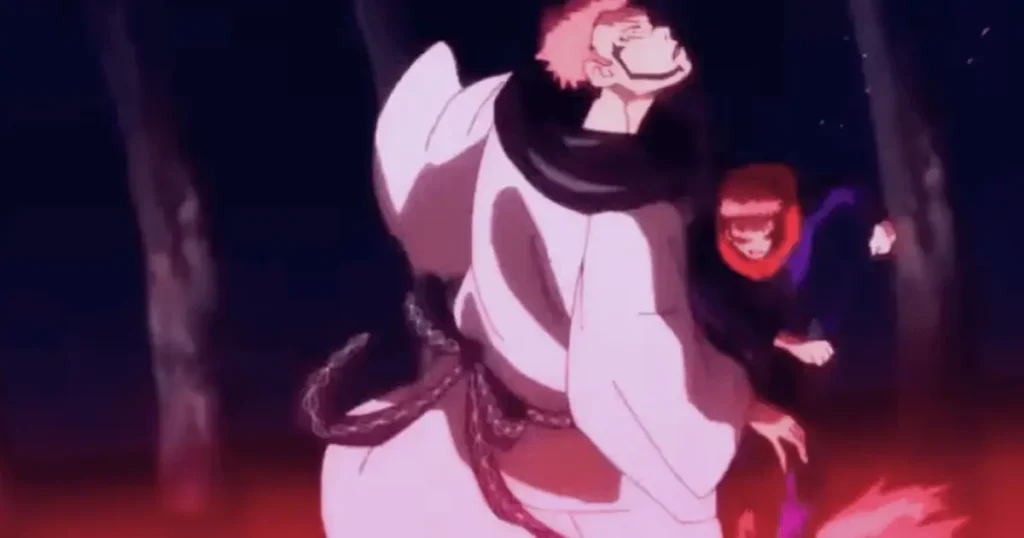
For most of Jujutsu Kaisen, imagining Yuji Itadori defeating Ryomen Sukuna would have sounded almost impossible. Sukuna is remembered as the strongest sorcerer of the Heian Era, a monster whose power left an entire generation of jujutsu sorcerers unable to defeat him. Yuji, meanwhile, begins the story as a high school student with extraordinary physical abilities but no knowledge of the world of jujutsu.
His journey takes an unexpected turn when he swallows one of Sukuna’s fingers to save his friends, becoming the King of Curses’ vessel.
The difference between them is enormous, and that’s exactly what makes their final confrontation so interesting. Gege Akutami doesn’t simply give Yuji enough power to match Sukuna. Instead, he gradually develops a fighting style built around several different abilities, hard-earned experience, and a very specific understanding of his opponent.
By the time the Shinjuku Showdown reaches its final stages, Yuji has developed tools that allow him to challenge Sukuna in ways that would have been unthinkable at the beginning of the series.
But there’s more to this evolution than a collection of new techniques. Some of Yuji’s most important advantages come from understanding the relationship between souls, knowing when to adapt, and recognizing that he doesn’t have to win the battle alone.
Warning: This article contains major manga spoilers, including the Shinjuku Showdown and the final battle against Sukuna.
From Sukuna’s Vessel to a Sorcerer With His Own Arsenal
For much of the story, Yuji wasn’t treated as a promising jujutsu sorcerer. He was treated as a potential disaster.
His position as Sukuna’s vessel made him a target for execution, even though Satoru Gojo believed there was a reason to keep him alive until all twenty of Sukuna’s fingers had been consumed.
What’s interesting is that Yuji was never physically ordinary. Even before learning about cursed energy, he possessed incredible strength, speed, and athletic ability. His early fights showed that he could compete with opponents who had years of experience in the world of jujutsu.
However, physical talent alone wasn’t enough to deal with someone like Sukuna.
As the story progressed, Yuji learned to control cursed energy, developed a better understanding of combat, and gained experience by fighting enemies who constantly pushed him beyond his limits. His battles against Mahito, the Culling Game participants, and eventually Sukuna all contributed to that growth.
Another important factor was his time sharing a body with Sukuna. As Kusakabe later explains, having Sukuna use jujutsu through Yuji’s body helped him develop a kind of muscle memory that accelerated his understanding of cursed energy manipulation.
For me, this is one of the most interesting details about Yuji’s progression. His growth isn’t completely separated from the enemy he eventually has to defeat. In a strange way, carrying Sukuna inside his body also gave him the opportunity to learn from the techniques that made the King of Curses so dangerous.
The Abilities That Helped Yuji Close the Gap With Sukuna
Gojo’s defeat changed the situation dramatically. The sorcerers could no longer rely on the strongest modern jujutsu sorcerer to deal with Sukuna, so the responsibility shifted to everyone who was still capable of fighting.
Yuji’s role became increasingly important, especially as he began revealing abilities that had either been hidden or developed during the preparations for the battle.
Several of these techniques would become essential to his eventual victory.
Black Flash: Yuji’s Exceptional Ability to Enter the Zone
Black Flash has always been one of Yuji’s most recognizable combat feats. He demonstrated an unusual affinity for it during his fight against Hanami, but his performance against Sukuna takes that ability to another level.
By landing multiple Black Flashes in succession, Yuji enters an awakened state that allows him to better understand and control his cursed energy.
This is especially important because Black Flash isn’t a technique that sorcerers can activate whenever they want. It occurs when cursed energy connects with a physical impact within an incredibly short window of time. Even experienced fighters cannot simply produce it on command.
Yuji’s ability to land several of these attacks during the Shinjuku Showdown demonstrates just how naturally he responds to that difficult timing.
More importantly, the phenomenon becomes a turning point in the fight. The repeated Black Flashes help Yuji reach a higher level of performance and bring out abilities that had remained dormant.
I think this is a much more satisfying way to develop his strength than simply giving him a transformation. Black Flash rewards his combat instincts and experience, while still maintaining the unpredictability that makes the technique special.
Reverse Cursed Technique: How Yuji Learned to Recover From Serious Injuries
One of Yuji’s biggest disadvantages against Sukuna was his vulnerability in prolonged battles.
Sukuna possesses an enormous amount of cursed energy and can use Reverse Cursed Technique to recover from severe injuries. Facing someone with that level of regeneration is difficult enough, but the problem becomes even worse when the fight involves several consecutive exchanges.
Yuji eventually masters Reverse Cursed Technique on his own.
This development is connected to the special training conducted before the Shinjuku Showdown. Through Ui Ui’s soul-swapping ability and exchanges with Yuta, Yuji gains the experience needed to understand how to heal his own body using reverse cursed energy.
His unusual constitution also helps. After absorbing the remaining Death Painting Wombs, Yuji gains Blood Manipulation and shares certain characteristics with the Death Paintings. Choso explains that this allows him to convert cursed energy into blood, making the process of learning Reverse Cursed Technique less demanding.
However, Yuji doesn’t become an expert overnight.
During the battle, he struggles to recover from particularly serious internal injuries. Choso helps him understand how to recognize and deal with that damage, giving Yuji a better chance of returning to the fight.
This limitation matters because it keeps the ability grounded. Yuji can recover from injuries that would otherwise take him out of combat, but he still has to manage his energy and recognize when his body is approaching its limits.
Blood Manipulation: A New Way to Attack and Defend
Blood Manipulation is another major addition to Yuji’s arsenal.
He acquires this cursed technique after absorbing Death Painting Wombs Four through Nine, giving him access to an ability previously associated with the Kamo clan and the Death Paintings.
The technique allows him to manipulate his own blood and opens up possibilities beyond his usual close-range fighting style.
During his preparation, Yuji receives guidance from both Choso and Noritoshi Kamo. He begins learning the fundamentals of Blood Manipulation, including Convergence, which compresses blood into a concentrated form that can be used for other techniques.
It’s important not to mistake this development for instant mastery. Choso possesses far more experience with Blood Manipulation, and Yuji doesn’t have the time to reproduce his entire arsenal before facing Sukuna.
Still, the technique gives him another tool to work with and complements his physical fighting style.
What I find particularly interesting is how Blood Manipulation also connects to Yuji’s ability to recover. It isn’t just another way to attack an opponent. His unusual physiology makes it part of the foundation that allows him to use Reverse Cursed Technique more effectively.
Shrine: Yuji Awakens the Same Cursed Technique as Sukuna
This is arguably the most surprising part of Yuji’s evolution.
As Sukuna’s vessel, Yuji gradually had the King of Curses’ technique engraved into his body. Gojo had previously suggested that this could eventually happen, and the awakening becomes apparent during the battle in Chapter 257.
After landing multiple Black Flashes, Yuji finally brings out Shrine.
However, his version isn’t identical in performance to Sukuna’s. The technique has only recently awakened, and its output is considerably lower than the version used by the King of Curses.
One of the most noticeable differences is the way Yuji’s attacks manifest. His cuts appear through distinctive patterns resembling scissors, allowing him to target objects and opponents with the technique.
The real importance of Shrine, though, goes beyond having access to Sukuna’s offensive ability.
Yuji learns to direct Dismantle toward the boundary between Sukuna’s soul and Megumi Fushiguro’s. Rather than relying exclusively on physical damage, he can attack the connection that allows Sukuna to maintain control over Megumi’s body.
That gives his new technique a very specific purpose in the final battle.
For me, this is one of the best details in Yuji’s entire development. He doesn’t simply inherit the same power as his enemy and try to overpower him with it. He finds a way to use that power against the particular weakness created by Sukuna’s possession of Megumi.
Yuji’s Domain Expansion: The Final Piece of His Evolution
Yuji’s Domain Expansion is another major milestone, first revealed in Chapter 264.
He learned the fundamentals of barrier techniques through his replacement training with Atsuya Kusakabe. This gave him the necessary foundation to develop one of the most advanced abilities in jujutsu.
The domain takes the shape of a familiar town connected to Yuji’s memories. Instead of immediately launching into another exchange of attacks, he uses this space to walk alongside Sukuna and attempt to reach him through a conversation.
The domain doesn’t have an officially revealed name, but its importance in the final battle is undeniable.
Its most significant combat feature is the sure-hit effect of Yuji’s Dismantle, which targets the boundary between Sukuna’s soul and Megumi’s. This allows Yuji to attack their connection without depending entirely on landing direct physical blows.
And that’s where the technique becomes particularly dangerous for Sukuna.
Yuji has spent much of the battle trying to weaken the connection between the two souls. Now, he has a Domain Expansion that can apply that attack through its sure-hit effect.
It’s a major advancement because Yuji isn’t simply adding another powerful ability to his arsenal. He’s developing a technique that directly supports the strategy he has been building throughout the confrontation.
How Did Yuji Actually Defeat Sukuna?
Understanding Yuji’s abilities is only part of the explanation. His victory also depends on how those abilities interact with Sukuna’s weaknesses and the actions of the other sorcerers.
One thing worth remembering is that Yuji never fights Sukuna under perfectly equal conditions. By the time their final exchanges take place, Sukuna has already faced Gojo and several other powerful opponents.
The accumulated damage and pressure from those battles make a difference.
Attacking the Boundary Between Sukuna and Megumi’s Souls
Sukuna’s possession of Megumi creates a weakness that Yuji is uniquely positioned to exploit.
Because he previously shared his body with Sukuna, Yuji has an unusual understanding of the relationship between the two souls. His attacks can target the boundary separating them, gradually weakening Sukuna’s hold over Megumi.
This is different from simply trying to inflict enough physical damage to defeat Sukuna.
Even when Sukuna manages to recover from injuries, he cannot easily undo the damage Yuji is causing to the connection between their souls.
Megumi’s resistance also becomes increasingly important as the fight progresses. The more unstable Sukuna’s control becomes, the greater the opportunity for Megumi to fight back from within his own body.
This is why Yuji’s strategy matters so much. He’s not merely trying to destroy the strongest enemy in the series. He’s trying to defeat that enemy without losing the friend trapped inside him.
How Nobara’s Return Changed the Final Battle
Nobara Kugisaki’s return is one of the most important moments in the final confrontation.
Using her Straw Doll Technique, Nobara activates Resonance against Sukuna’s remaining finger. The attack reaches him through the connection established by the cursed object and disrupts his ability to respond effectively.
The timing is crucial.
Sukuna is attempting to regain control of the battle, but Nobara’s intervention interferes with his ability to expand his domain. That gives Yuji an opportunity to activate the sure-hit effect of his own Domain Expansion and attack the boundary between the two souls.
It’s difficult to overstate how important this moment is.
Without Nobara’s intervention, Sukuna could have had another opportunity to turn the fight around. Her return doesn’t merely provide an emotional payoff for the audience — it directly changes the conditions of the final confrontation.
I also love how this connects to one of the series’ central relationships. Yuji, Megumi, and Nobara began the story as three students learning to survive the world of jujutsu together. Having Nobara play such an important role in the final battle gives their story a satisfying sense of closure.
The Final Blow: How Yuji Ended the Fight
After Nobara’s interference and the activation of Yuji’s domain, the battle reaches its decisive stage.
Yuji continues attacking Sukuna while trying to separate him from Megumi. The repeated strikes gradually weaken Sukuna’s position, and Megumi’s resistance becomes another obstacle the King of Curses can no longer ignore.
Sukuna still refuses to accept defeat, but his previous advantages have been reduced considerably.
By the time the final exchange arrives, Yuji has managed to combine everything he has developed throughout the story: physical strength, cursed energy control, Shrine, Reverse Cursed Technique, and the ability to target the boundary between souls.
He delivers the decisive blow with a Black Flash to Sukuna’s abdomen, knocking the King of Curses unconscious.
The confrontation ends with Sukuna’s defeat and his separation from Megumi’s body.
The victory is Yuji’s, but the conditions that made it possible were created by the combined efforts of everyone who fought alongside him.
A Victory Built by Many Hands, Not Just One
One of the things I appreciate most about the Shinjuku Showdown is that Akutami doesn’t turn the final battle into a situation where every other character becomes irrelevant so the protagonist can have his moment.
Yuji delivers the finishing blow, but several sorcerers play important roles in getting him there.
Hiromi Higuruma’s confrontation with Sukuna introduces the plan involving Deadly Sentencing and the Executioner’s Sword. Although the strategy doesn’t produce the clean result the sorcerers wanted, Higuruma forces Sukuna to deal with a very different kind of threat.
Yuta Okkotsu later brings his Domain Expansion into the battle, creating another opportunity to pressure Sukuna while fighting alongside Yuji and Rika.
Maki Zenin uses her exceptional physical abilities and the Split Soul Katana to attack Sukuna in ways that his usual defenses cannot easily handle.
Aoi Todo’s return is equally important. His Boogie Woogie allows him to reposition allies and create unexpected openings, making it much harder for Sukuna to control the battlefield.
Choso also deserves special recognition. Beyond helping Yuji understand Blood Manipulation and recovery, he sacrifices himself to protect his younger brother from Sukuna’s Divine Flame.
And, of course, Nobara’s Resonance provides the opening that makes the final stage of Yuji’s Domain Expansion possible.
Each character contributes something different.
For me, this is much more satisfying than a traditional final battle where the protagonist suddenly becomes strong enough to defeat everyone on his own. The other sorcerers aren’t there simply to make Yuji look better. Their decisions, sacrifices, and individual abilities genuinely shape the outcome.
What Yuji’s Evolution Represents Beyond Fighting Techniques
There’s another reason why the confrontation between Yuji and Sukuna works so well: their understanding of human life is almost completely incompatible.
Sukuna approaches existence through his own desires. He values strength, follows his impulses, and has little interest in the lives or feelings of people who stand in his way.
Yuji gradually develops a very different understanding of what makes a person’s life meaningful.
This becomes especially clear during their conversation inside Yuji’s Domain Expansion. Rather than immediately trying to overpower Sukuna, Yuji takes him through places connected to his childhood and talks about ordinary experiences that helped shape his understanding of life.
He explains that a person’s value isn’t necessarily defined by their position, achievements, or the role they play in society. Even small memories and everyday experiences can leave something meaningful behind.
Sukuna rejects that perspective.
And that’s what makes their final confrontation more interesting than a simple battle between two characters with different levels of power.
Yuji isn’t trying to become another Sukuna. He doesn’t abandon his belief that human lives have value simply because his opponent refuses to recognize it.
Instead, he finds a way to fight someone who represents almost everything he stands against.
I think that’s the most important part of Yuji’s development. His strength isn’t just the result of learning new techniques. It’s also the fact that he can face an opponent who has experienced centuries of violence without allowing that violence to completely define who he becomes.
Conclusion: How Did Yuji Become Strong Enough to Defeat Sukuna?
Yuji Itadori’s victory over Sukuna wasn’t the result of one unexpected transformation or a sudden increase in raw power. It came from the combination of abilities, experience, preparation, and teamwork that gradually shaped him into a much more capable sorcerer.
Black Flash helped push his combat performance to another level. Reverse Cursed Technique gave him a way to survive devastating injuries. Blood Manipulation expanded his options, while Shrine gave him the ability to attack the boundary between Sukuna and Megumi’s souls.
His Domain Expansion brought those developments together, providing a way to apply that soul-targeting attack through a sure-hit effect.
But none of these abilities would have guaranteed victory on their own. The damage Sukuna had already suffered, the efforts of the other sorcerers, Nobara’s return, and Megumi’s resistance all played important roles in the outcome.
What makes this battle special to me is that Yuji never needed to become the strongest sorcerer in history to defeat the King of Curses. He needed to understand his opponent, recognize the weaknesses he could exploit, and keep fighting even when the situation seemed hopeless.
And perhaps that’s the most fitting way for his journey to end: not by replacing Sukuna as another symbol of overwhelming power, but by proving that strength can mean something very different.
Read more from our Jujutsu Kaisen coverage: How Does Hakari’s Domain Expansion Work? Understanding One of the Series’ Most Unusual Abilities.
Now I want to hear your opinion: Do you think Yuji’s evolution was one of the best parts of Jujutsu Kaisen’s final arc? And which of his abilities made the biggest difference against Sukuna? Share your thoughts in the comments!
Featured image: Jujutsu Kaisen, created by Gege Akutami (MAPPA / Crunchyroll).